Library Visits

You must have a school ID and a library pass signed by your teacher to check out books or use the computers.

Showing posts with label march reading madness. Show all posts

Friday, March 20, 2015

Library Word of the Week ... AND March Reading Madness ROUND 3

March Reading Madness Round 3


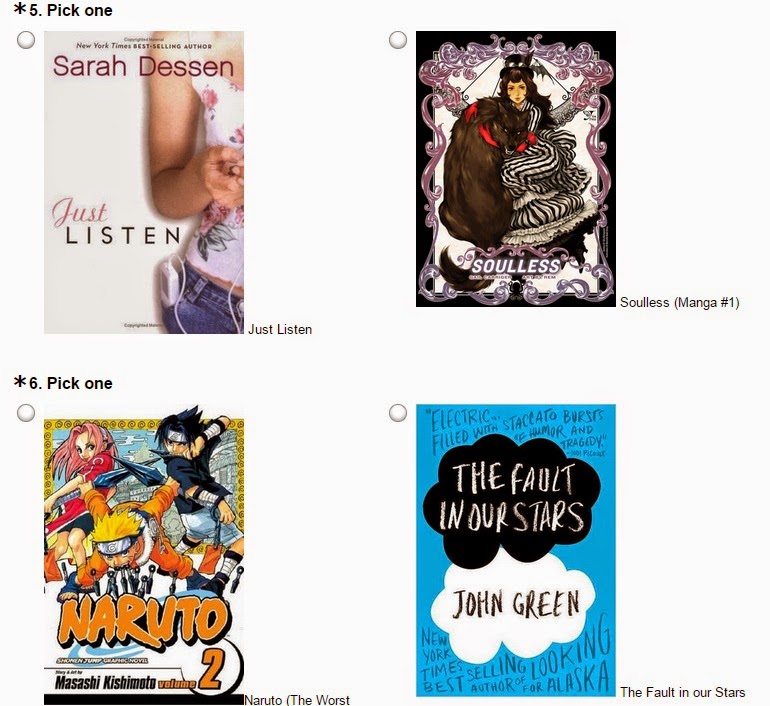
YOUR picks that have made it to Round 3, the SEMI-FINALS are: 

 Versus 


and 


Vote for your favorites and watch here to see who makes it to the finals! 

In other news: 


Our library word of the week is: Plagiarism. 
Students do a lot of research, and it is so easy to just copy & paste information without giving credit to the original author. However, this is illegal. If someone creates something (art, a paper, a book, music), that belongs to them. It is their work. 

Take a look at http://www.plagiarism.org/plagiarism-101/what-is-plagiarism/ for more information. 


Monday, March 9, 2015

March Reading Madness Round 2

March Reading Madness Round 2 voting is here: 

March Reading Madness Round 1 is OVER. Our first round winners are:

 Catching Fire by Suzanne Collins

 City of Glass by Cassandra Clare

Destiny's Hand Fiendish by Brenna Yovanoff

Etiquette and Espionage (Finishing School #1) Etiquette & Espionage by Gail Carriger

The Fault in our Stars The Fault in our Stars by John Green

Soulless (Manga, #1) Soulless by Gail Carriger

The Immortal Life of Henrietta Lacks Vampire Academy by Richelle Mead

Thirteen Reasons Why Thirteen Reasons Why by Jay Asher

Make sure you vote for your ROUND 2 PICKS!

Friday, March 6, 2015

Library Word of the Week ... and a few updates

Ms. D had an interesting experience today where she had to pull from her language knowledge to troubleshoot a printer. The printer had accidentally be set to French!

Did you know that a lot of our words are actually French words? Check out the Wiki page here: French Expressions In English.

One that students likely see often, especially in history class is: 

laissez-faire
lit. "let do"; often used within the context of economic policy or political philosophy, meaning leaving alone, or non-interference. The phrase is the shortcut of Laissez faire, laissez passer, a doctrine first supported by the Physiocrats in the 18th century. The motto was invented by Vincent de Gournay, and it became popular among supporters of free-trade and economic liberalism. It is also used to describe a parental style in developmental psychology, where the parent(s) does not apply rules or guiding. As per the parental style, it is now one of the major management styles.

Our other updates are...

March Reading Madness round 1 ends TONIGHT. 
Round 2 will be posted some point tomorrow. Keep an eye out. 

Funds4Books ends TODAY. Thank you to all who donated!


Friday, February 27, 2015

March Reading Madness - Update

The current leaders in March Reading Madness ROUND 1 are: 


Don't forget to vote for your favorites,
and you can vote more than once!

Round 1 will close March 6th and 
Round 2 will start March 7th. 

Library Word of the Week - March Madness Edition

March is almost here, and with it, basketball season. I know here at HSC we have some amazing players who want to play for the NBA, and I certainly hope that some of them make it.

With that in mind, not only are we doing a March Reading Madness bracket (found both in person at the library and online here: March Reading Madness Vote), but the Library Word of the Week is actually a short History of Basketball. After all, Springfield is the home of the Basketball Hall of Fame.


Basketball originated in 1891 when a future Presbyterian minister named James Naismith (1861-1939) was assigned to teach a physical education class at a Young Men's Christian Association(YMCA) training school in Springfield, Massachusetts. The class had been noted for being disorderly, and Naismith was told to invent a new game to keep the young men occupied. Since it was winter and very cold outside, a game that could be played indoors was desirable.

Naismith thought back to his boyhood in Canada, where he and his friends had played "duck on a rock," which involved trying to knock a large rock off a boulder by throwing smaller rocks at it. He also recalled watching rugby players toss a ball into a box in a gymnasium. He had the idea of nailing up raised boxes into which players would attempt to throw a ball. When boxes couldn't be found, he used peach baskets. According to Alexander Wolff, in his book 100 Years of Hoops, Naismith drew up the rules for the new game in "about an hour." Most of them still apply in some form today.

So enjoy some hoops, learn about the history, and follow our Reading Madness bracket. 

Tuesday, February 24, 2015

March Reading Madness

VOTE for your favorite books!
Go to Round 1 of our March Reading Madness survey to pick your favorites out of the
TOP 16 circulated titles!

Can YOUR favorite book win March Reading Madness? 

March Reading Madness Round 1